Commercial Waste Collection London: Insurance & Safety
 In the busy environment of Commercial Waste Collection London, health and safety are as important as timely pickups and sustainable disposal. This page outlines how our commercial waste collection in London services prioritise protection for clients, staff and the public through robust insurance cover, comprehensive training programmes and a systematic risk assessment process. We explain the practical measures that underpin our operations and how we minimise liability while maintaining efficiency. Safety-first practices are embedded in every stage of our London commercial waste collection operations.
Public Liability Insurance: What It Covers
Our public liability insurance is designed specifically for commercial waste services in London and provides financial protection against third-party claims for property damage, bodily injury or accidental contamination during waste collection activities. The policy covers incidents that occur on client premises and in public spaces during transfer and transport of waste. Insurance limits and policy inclusions are regularly reviewed to ensure coverage is appropriate for the scale of our operations and the range of materials we handle, from general refuse to mixed commercial recyclables.
 We believe transparency about insurance is essential. Clients engaging our waste collection for businesses in London can expect documentation of coverage on request, including certificates of insurance that show cover limits, indemnity periods and any applicable exclusions. While policies vary by region and type of service, our commitment is consistent: maintain sufficient public liability cover so that customers, employees and members of the public are protected in the unlikely event of an incident.
Staff Training and Competency
All personnel working in London commercial waste collection receive structured training that combines classroom instruction with hands-on experience. Training topics include manual handling, safe lifting techniques, hazardous waste awareness, vehicle loading and secure containment. Emphasis is placed on legal requirements, environmental responsibilities and customer-site protocols. Competency assessments are performed periodically to ensure ongoing proficiency and to identify any additional refresher training needs.
 Training is reinforced by on-the-job supervision and documented performance checks. New recruits complete induction modules that explain company policies, emergency procedures and the correct use of personal protective equipment. Supervisors carry out toolbox talks and briefings to address daily hazards specific to each collection route or customer site, ensuring that best practices for commercial refuse collection in London are consistently applied.
Key training elements include:
- Manual handling and ergonomic techniques to reduce injury;
- Hazard recognition for sharps, liquids and potentially contaminated waste;
- Vehicle safety procedures, including loading, securing and vehicle checks;
- Customer interaction and site-specific access protocols.
Personal Protective Equipment (PPE) and Safety Gear
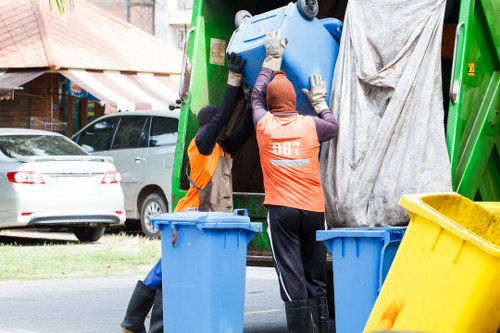
PPE is mandatory for all crew members involved in waste handling. Standard issue includes high-visibility clothing, steel-toe boots, heavy-duty gloves, eye protection and respiratory protection where dust or fumes may be present. For specialist tasks, such as handling chemical wastes or clinical refuse, additional protective suits and respirators are provided. PPE selection follows a risk-based approach and is aligned with the risk assessment findings for each task or site.
 The condition and suitability of PPE are inspected daily; damaged items are replaced immediately. We emphasise correct use, storage and maintenance of protective equipment so that PPE functions as an effective barrier. Training covers the correct sequence of donning and doffing, particularly important when dealing with potentially infectious materials, to prevent contamination and reduce the likelihood of cross-contamination during transfer or disposal.
 Risk assessment is central to safe commercial waste collection in the capital. Our process begins with the identification of hazards at every stage—collection points, transit routes, loading areas and disposal facilities. Each risk is evaluated for likelihood and potential impact, then prioritised. Controls are implemented using the hierarchy of risk control: elimination, substitution, engineering controls, administrative controls and finally PPE as a last line of defence. Records are maintained for each assessment and are subject to routine review to capture changes in operations, new client requirements or regulatory updates.
Emergency preparedness and incident response are integrated into our safety management system. Crew members are trained in spill containment, incident reporting and first aid so that any event—however rare—can be managed promptly and professionally. Post-incident investigations identify root causes and corrective actions to prevent recurrence. This continuous improvement loop helps our commercial waste collection operations in London stay resilient and compliant.
We also emphasise documentation: job hazard analyses, toolbox talk records, PPE issue logs and training certificates are all part of comprehensive record-keeping. These records support audit activities, facilitate regulatory compliance and demonstrate due diligence in managing safety responsibilities for waste collection of businesses across London. Accountability at every level ensures policies are not only written, but lived by.
By combining robust public liability insurance, thorough staff training, appropriate PPE and a systematic risk assessment process, our approach to commercial rubbish collection London ensures that safety and liability are managed proactively. This integrated strategy reduces risk, protects stakeholders and supports reliable, responsible waste management across the city.