Commercial Waste Collection London: Recycling & Sustainability Strategy
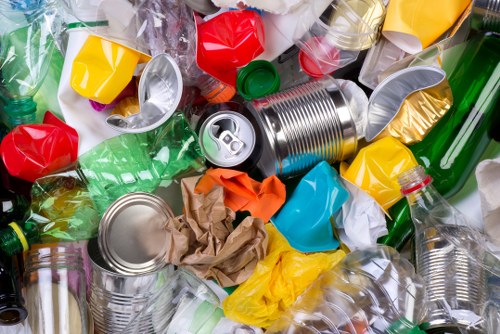 Commercial Waste Collection London services are evolving to meet the capital's ambitious environmental targets. Our approach to commercial recycling and sustainable waste management focuses on diverting material from landfill, improving recycling quality and reducing emissions from collections. The programme aligns with a clear recycling percentage target: we aim for a minimum 65% recycling rate across commercial contracts by 2030, with interim milestones to drive continuous improvement.
Across central and greater London, businesses face a range of local rules and opportunities for separation at source. Many boroughs have distinct policies — for example, some inner boroughs emphasise separate food waste collections from restaurants and markets, while others require clear separation of paper, card, glass and mixed plastics. Our commercial waste collection in London systems are tailored to borough-specific requirements, ensuring compliance and maximising recovery.
![A row of four large blue wheelie bins located on a paved outdoor surface against a grey concrete wall. The first bin on the left is filled with mixed cardboard and paper packaging, with some pieces leaning over the edge. The second bin also contains a pile of flattened cardboard boxes and paper waste, with some materials protruding from the top. The third bin appears to contain cardboard and paper, with a partially visible black plastic bag among the waste. The fourth bin has a similar assortment of paper and cardboard, with some pieces leaning outside the bin. On the ground in front of the bins, there is a white plastic lid or tray, resting on a textured pavement close to the curb. The environment suggests an urban or commercial waste collection point, consistent with services offered by Commercial Waste Collection London, supporting rubbish removal and recycling efforts in the local area near London postcode regions, possibly within the vicinity of [POSTCODE] or [TOWN]. The clear daylight and neutral surroundings emphasize the focus on waste storage and management for sustainable disposal practices.](/pub/_photos/rubbish/f1340881416.jpg) To support the municipal approach, our London commercial waste recycling programmes coordinate with local transfer stations and material recovery facilities. These transfer stations act as hubs: materials are consolidated, sorted and sent to the most appropriate recycling or reprocessing outlets. By routing collections through nearby transfer stations we cut journey miles and handling time, improving throughput to recycling operations and lowering overall carbon intensity.
To support the municipal approach, our London commercial waste recycling programmes coordinate with local transfer stations and material recovery facilities. These transfer stations act as hubs: materials are consolidated, sorted and sent to the most appropriate recycling or reprocessing outlets. By routing collections through nearby transfer stations we cut journey miles and handling time, improving throughput to recycling operations and lowering overall carbon intensity.
We prioritise partnerships with charities and social enterprises to extend the life of commercial items. Textile reuse from retailers and hospitality linens is collected separately and directed to third-sector partners for sorting and redistribution. Similarly, surplus office equipment and furniture recovered by our business waste collection services in London are offered to registered charities before they enter recycling streams. These collaborations reduce waste, support local communities and create circular economy jobs.
 Investment in a low-carbon fleet is central to our sustainable commercial waste collection strategy. We operate a growing number of low-emission vans and electric rigid vehicles for inner-London routes, coupled with route-optimisation software to minimise mileage. This reduces NOx and CO2 emissions from collections, helping businesses meet their Scope 1 and Scope 3 targets and supporting boroughs' air quality objectives.
Operational best practice also includes segregation training for site staff and clear labelling of containers. We provide visual aids and step-by-step waste separation instructions aligned with borough collection schemes so that paper, card, glass, mixed recycling, food and residual waste are presented correctly at the kerb for efficient processing by transfer stations and reprocessors.
To measure progress we use transparent reporting dashboards: each contract receives monthly audits showing tonnages, contamination rates and the recycling percentage achieved. Our target-driven model rewards higher capture rates of recyclables and penalises persistent contamination. The recycling percentage target is complemented by a reduction in residual waste per metre squared for commercial premises.
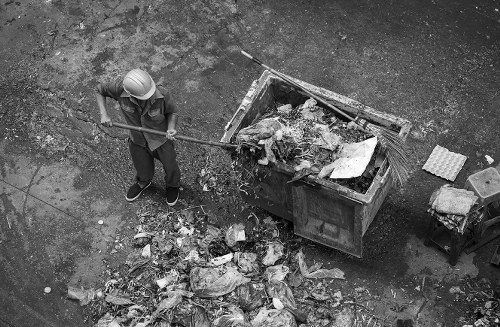 We also provide tailored reuse and recycling streams for common London commercial wastes: electronic waste (WEEE) from offices and shops, food waste from restaurants and catering, construction and demolition waste for redevelopment sites, and soft textiles from fashion retailers. Our London commercial recycling services include specialised bulking and secure data-destruct services for sensitive equipment, ensuring materials are recovered where possible and confidential data is protected.
 Our service network spans multiple boroughs, enabling flexible solutions whether you operate in Camden, Hackney, Westminster or outer-London boroughs. We work with local authorities and transfer stations to reconcile borough-specific rules — for example, some areas require separate caddy collections for food waste, while others accept co-mingled organics — and we adapt collection streams accordingly to maximise recycling outcomes.
Key elements of our sustainable commercial waste collection offer
- Recycling target: 65% minimum commercial recycling rate by 2030 with interim milestones.
- Local transfer stations: Reduced haul distances and improved material routing through borough hubs.
- Charity partnerships: Reuse-first approach for textiles, furniture and surplus supplies delivered to community organisations.
- Low-carbon fleet: Electric and low-emission vehicles for urban routes and optimised collection scheduling.
- Compliance: Customised services reflecting each borough's waste separation policies.
Why choose our London commercial waste and recycling solutions?
Choosing a sustainable commercial waste collector in London means more than removing refuse: it means partnering to reduce environmental impact, enhance resource recovery and comply with borough regulations. Our integrated approach combines clear recycling goals, local transfer station logistics, strategic charity partnerships and investments in low-carbon vans to deliver a resilient, future-ready service. Strong operational controls, robust reporting and customer-focused guidance help businesses meet both regulatory requirements and corporate sustainability goals while supporting London's transition to a circular economy.
Together, we can reduce waste, increase recycling and cut emissions — one collection at a time.